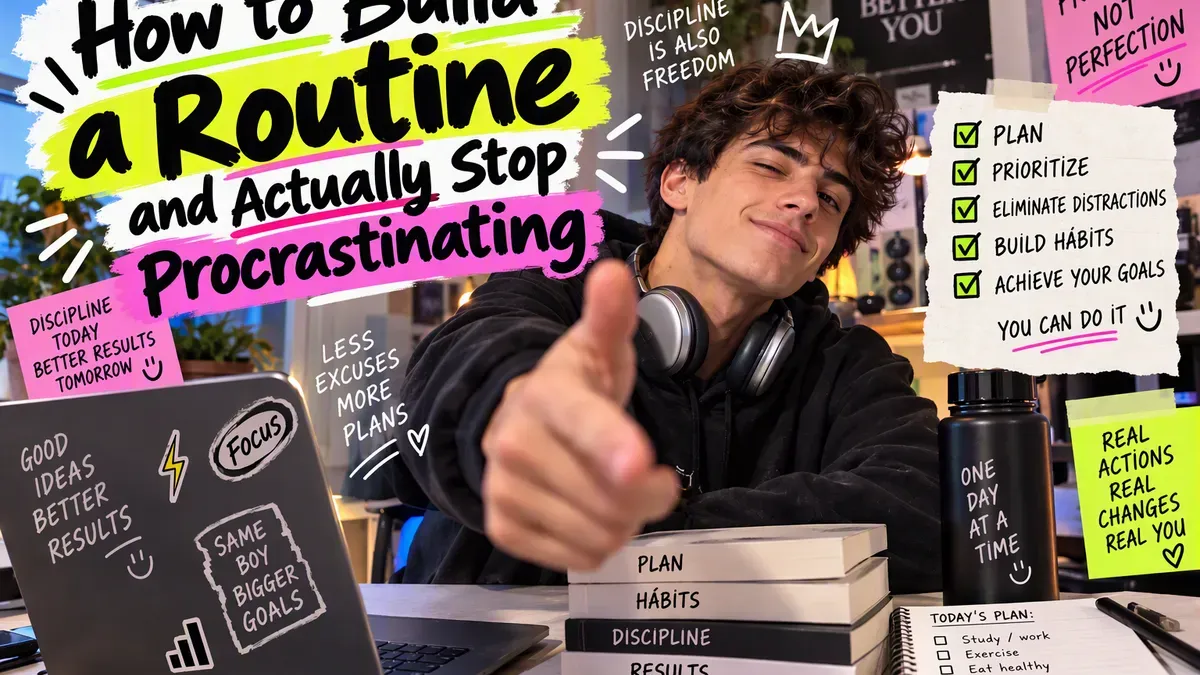
Productivity for young people isn’t about filling your calendar with impossible tasks. It’s about finding a rhythm that actually works for you. Here are tips that hold up.
Short answer: procrastination isn’t laziness, it’s almost always a design problem. When a task makes you resist, it’s rarely the task itself. It’s that you don’t know where to start, the finish line isn’t defined, or you’re afraid of failing at it. Fix that and the resistance disappears on its own.
Why you actually procrastinate
A study by Steel (2007) offers the most widely accepted explanation: people postpone tasks that generate anxiety. Not out of laziness, but because uncertainty weighs more than effort.
That explains why a ten-minute task comes naturally and a three-hour exam gets pushed fifteen days out. It’s not that you can’t do it. It’s that the task was never broken into pieces.
The fix isn’t motivating yourself harder. It’s shrinking the task until it becomes obvious.
Drop multitasking
Doing several things at once only makes you slower. Your brain doesn’t process two tasks in parallel: it switches between them, and every switch costs roughly twenty minutes. Five study tabs open at once isn’t two hours of focused work, it’s two hours with five restarts.
Focus on one thing, set a 25-minute timer and see what happens. Pomodoro works because it removes the decision: you don’t have to decide how long to focus, you just turn it on.
One important nuance: the 25 minutes are a starting point, not a ceiling. If you’ve been going an hour and you’re still in flow, keep going. The timer is a launchpad, not a roof.
Break big tasks into pieces
The most expensive mistake of your late teens is telling yourself “finish the class project” with no idea where that starts. That’s a three-hour task disguised as a five-minute one.
Rewrite it like this:
- Open the document and type the title. (2 min)
- Do the bibliography, even if it’s ugly. (20 min)
- Write the first paragraph even if it’s bad. (15 min)
- Fix the spelling. (15 min)
Every line has a clear beginning and end. None of them makes you anxious. And the first one is so small there’s no excuse left.
The active rest technique
Resting isn’t scrolling your phone. Stretching, walking or just breathing recharges your brain far better.
Five minutes of scrolling feels like a break, but it’s actually a task switch: you go from deep work to variable stimulation, and coming back costs double. That’s not relaxation, that’s escape.
A real break lasts about as long as your attention holds out, somewhere between 10 and 20 minutes, and it keeps your hands away from your phone. Walk, stretch, look out the window, eat something. Anything that doesn’t deliver fast dopamine.
Your environment is your mood
A tidy desk isn’t boringness, it’s mental clarity. Spray your favorite cologne, put on your study playlist.
This isn’t decoration. When something interrupts you, the cost isn’t only the interruption, it’s rebuilding the context. If it takes ten minutes to get focused again, every interruption costs a quarter hour. A desk where the exam folder is already closed drops interruptions to nearly zero.
Three changes with immediate impact:
- Phone in another room. Not face-up in airplane mode on the desk. That “quick glance” temptation is real and it always costs more than it looks.
- One tab per task. Close everything else. If you need to look something up, open it after.
- Set up the night before. Notebook open, water filled, clothes on. Removing the friction of starting is the most underrated lever there is.
Build habits that survive a bad day
The flaw in almost every productivity system is that it assumes you’ll be motivated every day. You won’t be. The system has to work on a day when you’re wrecked, because that’s the day that counts.
- Minimum habits: two minutes a day is already a start. The smallest version of a routine you can do even when you’re tired keeps the chain alive.
- Visual reminders: sticky notes on your mirror or your lock screen. They work because they attack the moment of forgetting, not the moment of willpower.
- Real rewards: celebrate every win. Not on your phone, which is the opposite of a reward: it’s more stimulation. Go for a walk, eat something you like.
- The two-minute rule at the start: if it takes under two minutes, do it now. The cost of stacking up small tasks dominates the whole day.
- Never break the chain twice: missing a day is normal. Missing two is the start of quitting. If Tuesday didn’t happen, Wednesday comes back even if it’s only halfway.
When to stop and rest completely
There’s a limit internet productivity advice never mentions: rest doesn’t extract. Six hours of nonstop studying doesn’t produce six hours of work. It produces three hours and an exhaustion that lasts until Sunday.
Plan the rest before you start, not once you’re already burned out. If you have an exam Tuesday, Monday afternoon is not the time to “render it later.” It’s the time to sleep.
And if focus problems last for weeks, everywhere, despite getting enough sleep, that’s no longer a method problem. Talk to someone. A mental health professional can spot it in one session, and it’s a lot cheaper than a whole semester of failed attempts.
What actually matters
It’s not about being perfect, it’s about being consistent. And consistent means flexible: the routine you can keep on a Tuesday night with 40% battery is better than the perfect routine that only exists inside articles.
Start with one thing. Just one. And when it becomes easy to repeat, add the next one.
If you read this far and only keep one idea, make it this one: shrink the task until it’s obvious. Everything else is decoration.