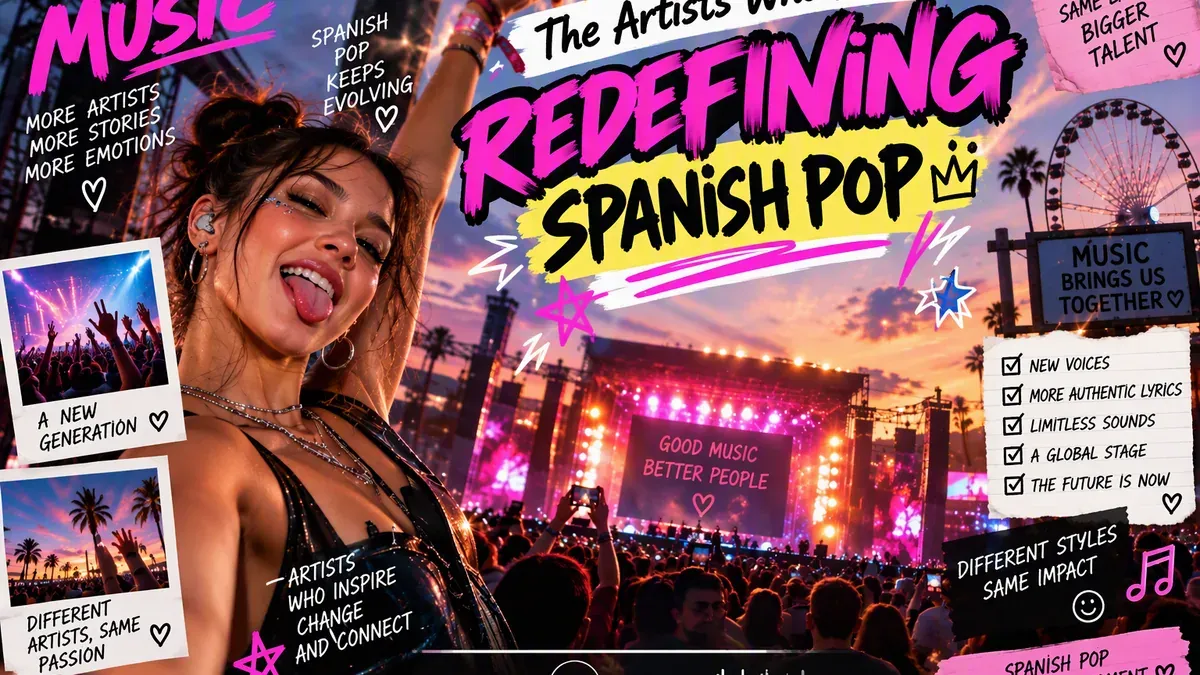
Spanish pop is having its best run: an artist can go from recording in their bedroom to filling stadiums in under a year. No label, no company, just a sound of their own and a song people replay on their own.
The formula behind a viral hit
Algorithms do the heavy lifting for artists nobody knows. Spotify, Apple Music and YouTube push new songs, and they do it better the more complete your listening history.
The second engine is editorial playlists, made by real people at the platform. Land on a new-releases list and a song reaches thousands who weren’t looking for it: the mechanism that put “Despacito” on every phone, now aimed at unknown artists.
The third is your peer group. Word of mouth between people your age moves more music than any publication. When several of you land on the same song, it multiplies.
And one factor that’s dumb but real: format. Short songs, a hook that lands on the first listen, a moment you can clip into a ten-second video.
The “-core” suffix obsession labels the moment, though the name matters less than the sound. The playlists that work share one recipe: pop, urban and electronic with obvious hooks.
Voices you can’t ignore
Nathy Peluso: pop brave enough to sound weird
Nathy Peluso is from Sabadell, and she’s pushed what a Spanish pop song can be further than almost anyone. She mixes electronic, funk and jazz-pop on one track and sings it in Spanish without worrying it sounds forced. “Mala Persona” and “Lo que me importa” land like stadium songs. Her trick: an unexpected twist that still fits.
Judeline: Latin energy, no filter
Judeline is the other face of Spanish urban pop: Madrid, heavy rhythm, sticky melodies and a presence that works in a small venue as well as in a video with millions of views. She isn’t inventing a sound, she’s making one hers with Latin American influences, no permission asked. Her case matters socially too: a generation done translating itself for everyone.
Rels B and Quevedo: when pop goes urban
Rels B took electronic pop and dropped it into the trap mold, visuals and loops included. “CosMOS” sounds like a club track and also works sung in a parked car. When the beat lands, lyrics barely matter.
Quevedo plays the opposite side and gets just as far. He started on raw rap and moved toward cleaner, danceable pop. “Ojos verdes,” with Aitana, works as a party song, an emotional moment and a meme at once. Few artists hold all three at once.
Aitana, Arca and Chesca: three different paths
Aitana proves a good strategy works. She started uploading songs, played small venues, and ended up representing Spain at Eurovision in 2024 with “Eurotrash.” Her sound is big pop built for choreography and packed rooms. You don’t need to sound weird, you need to land.
Arca is the counterpoint. Venetian, formed in Spain, she’s spent years making experimental electronic pop. If you only play commercial pop she sounds distant. Actually listen, and you get why people call her a renovator.
Chesca is the opposite story: an Argentine artist who started in her own country’s pop and found her audience in Spain with songs like “Loto.” She never studied the local market, did what came naturally, and it worked. Proof the Spanish-language market has no borders.
How to find music your algorithm doesn’t play
All of the above is useless if your playlist is a closed loop. Four moves that work:
- Raise the share of the unknown. Spotify and Apple Music both let you blend what you know with what’s new. Set it to max for a week: uncomfortable, and it works.
- Get off the charts. Top lists are made of things you already know work. Check new-releases lists and “artists like this” pages.
- Search by scene, not by name. Type “Spanish indie pop,” “dembow” or “electronic pop in Spanish.” You’ll find things no algorithm showed you.
- Leave the app. Record shops, radio, SoundCloud, local bands. That’s where the uncatalogued stuff shows up.
And the simplest one: ask someone who listens differently than you. If they’ve got a forty-song playlist you’ve never heard, that’s your next afternoon.
Common mistakes when something new comes on
- Only ever keeping what you already know. It’s comfortable, and it’s why your taste stalls. Bail in the first thirty seconds and you’ll never know whether you liked it.
- Confusing trend with quality. A song can be everywhere and still be bad. Appearing in every video doesn’t make it the best song of the year.
- Not saving what you like. Sounds obvious, almost nobody does it. Skip your library and the algorithm won’t serve it again, so you lose it. Save it the same day.
Recommended playlist
- To start the day: urgent pop with a beat. Nathy Peluso, Rels B or Judeline. Songs that get you moving without thinking.
- For the drama: emotional pop with a real voice. Aitana, Quevedo and Chesca. What you put on when everything’s going wrong and you need two minutes of someone who gets it.
- To dance: anything with a pulse. C. Tangana, Arca and electronic pop in general.
FAQ
Who’s the most breakout artist in Spanish pop right now?
Depends what you’re measuring. On the charts it’s whoever’s pushing hardest, usually someone fresh out of the playlist circuit. On sound there are artists with more craft and less noise. Growth shows up on platforms before it shows up in the press.
Why do so many artists sing in Spanish when English music is bigger worldwide?
Because the Spanish-speaking audience was underserved. For years artists here either moved to the English market or went quiet, and the scene never grew. Once there was enough good music, the audience showed up. The barrier in is close to zero.
Is urban pop better than electronic pop?
It’s not a race, they’re two families with different audiences. Urban hits harder at house parties and small venues, electronic works better on big stages. What’s happening now is the crossover: producers take from both, the most interesting zone.
Is it worth making music if nobody knows you yet?
Yes, but change what you’re measuring. Viral success is a lottery; writing, producing and playing live are not. Enjoy the process and there’s a plan; want only listeners, and the algorithm is a fragile goal.
Music changes faster than almost anything else we consume. What sounds weird today can be normal in two years, and the reverse. What’s a song you play on repeat and still can’t explain?